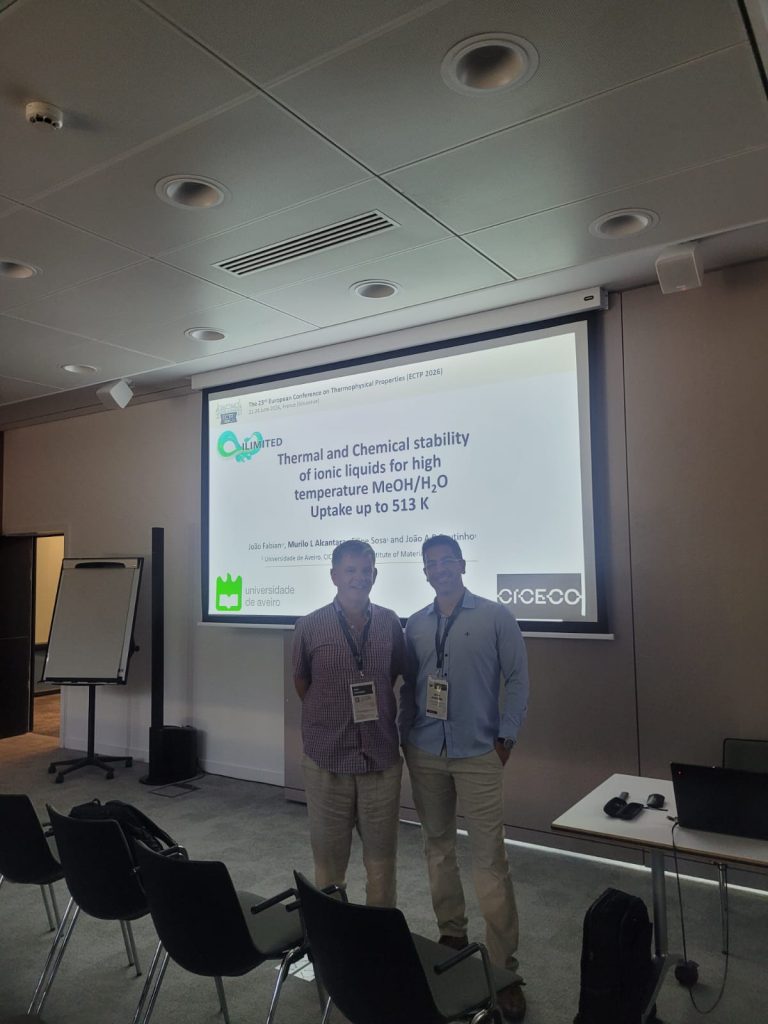
The ILIMITED project was represented at the 23rd European Conference on Thermophysical Properties (ECTP 2026), held from 21 to 24 June in Gouvieux, near Paris — one of Europe’s foremost conferences dedicated to the properties of materials. Murilo Alcantara and Prof. João Coutinho, of the University of Aveiro (CICECO), presented the work “Thermal and Chemical Stability of Ionic Liquids for High-Temperature MeOH/H₂O Uptake up to 513 K”, co-authored with João Fabian and Filipe Sosa.
ILIMITED aims to make CO₂-to-methanol production more efficient by using ionic liquids as “sponges” that absorb methanol and water as they form, shifting the reaction equilibrium and increasing yield. The challenge lies in the operating temperature: the process runs at around 240 °C, a point at which most solvents lose their stability long before reaching it.
This is precisely where the project’s contribution comes in — separating candidates that merely look promising from those that genuinely hold up under heat. The work began with a computational screening of an extensive library of ionic liquids and was completed with laboratory measurements of the properties that most affect operation: density, viscosity, melting behaviour and, above all, long-term thermal stability. Rather than relying on the standard “instant” decomposition temperatures, which tend to overestimate how long a liquid actually lasts in practice, the project applied a more realistic indicator — the temperature at which a material loses 1% of its mass over 10 hours.
The message that came out of the conference is one that runs through the whole project: stability is not assumed, it is proven. It is an essential step towards ILIMITED’s target of surpassing 80% yield in methanol synthesis.